Systems / Product Thinking · Academic Research · UnitedWorld Institute of Design
Digital Justice, Interrupted
India spent ₹2,600 crores digitizing 18,735 courts. The backlog grew anyway. A two-part systems study of why, and a proposed intervention built from the workarounds keeping the courts alive.
Read this firstThis is an academic research project built entirely on desk research: policy documents, audit reports, and published studies. No courtroom fieldwork, no interviews. Every figure on this page is an estimate from those sources, and the proposed intervention is an untested hypothesis. That honesty is part of the work.

18,000 courts. One broken system. Years of reform. It barely works.
A breakdown of where it fails, how it fails, and what that costs everyone.
01
The Paradox
In 2005, India launched one of the largest judicial digitization projects in the world. The promise was simple: technology would speed up justice. Twenty years later, the crisis it was built to solve has accelerated.
The standard explanations are inadequate training and insufficient funding. Both have been addressed repeatedly, and neither fixed anything. Our research question became: what if the technology is not failing the institution, but the institution is rejecting the technology?
We analysed the system using IAD and Resilience Engineering, working from policy documents, court data, and published studies. The answer was not a broken feature. It was a structural pattern that no amount of software could fix.
02
Two Courtrooms
Every Indian court runs two systems at once. The one on paper in Delhi, and the one that actually processes cases.
As designed
- Digital-first, paper eliminated
- Standardized procedure for every case type
- Centralized control through the e-Committee
- Transparent portal, automatic notifications
- Designed by policymakers and vendors
As it runs
- Paper and digital in parallel, everywhere
- Procedure improvised case by case
- Local workarounds, unauthorized but essential
- Information flows by phone call, through clerks
- Run by eight actor groups with conflicting incentives
The formal system was designed for judges, lawyers, clerks, and litigants, but largely without them. Policymakers and vendors built for an abstract user who follows mandated procedure. The real arena holds eight actor groups, and none of them optimize for the same outcome: policymakers want compliance, judges want discretion, staff want manageable workloads, litigants want resolution, and lawyers, inconveniently, profit when the system stays complex.
We mapped the case filing journey lane by lane, separating what humans do from what the IT system does. Nearly every breakdown sits at a handoff between lanes: where a rigid validation rule meets a messy human document, where a failed notification meets a litigant who never knew to check.
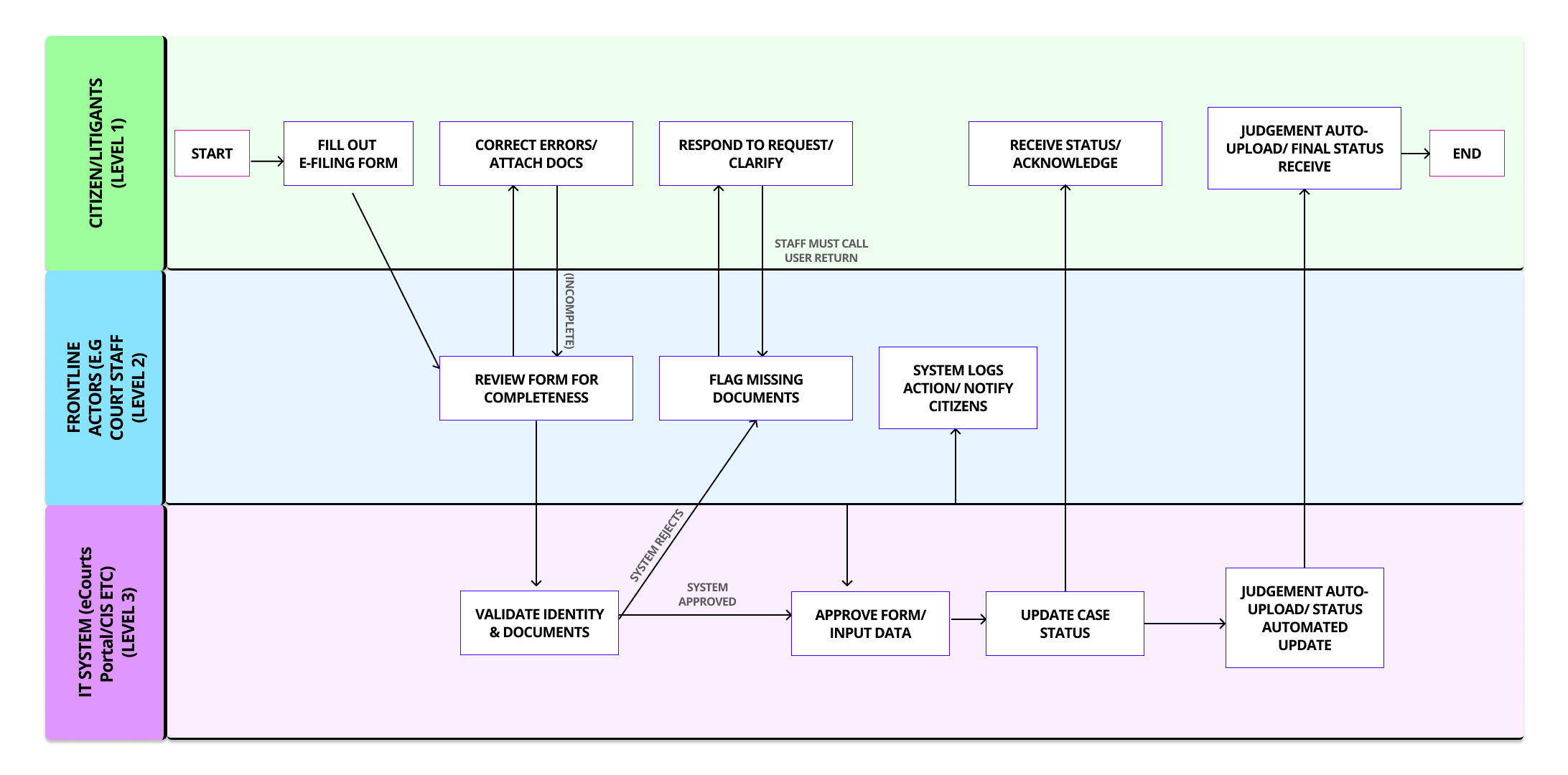
Case filing, lane by lane. The friction lives at the seams between the social system and the technical one.
03
The Workarounds
The most important findings in the research are four improvisations, documented across published studies, that practitioners invented to keep broken procedures moving.
The misscan trick
The portal auto-rejects filings for minor format errors, and the error messages are jargon nobody can act on. So court staff print the rejected document, correct it by hand in the margins, and re-scan it labelled "document re-scanned, misscan error". The system accepts it and opens a 48-hour window for manual data completion. A fake error code is doing the work the design should have done.
The human search engine
The portal can only find a case if you type the exact case number. Most litigants were never given one. So they phone the court, and a clerk searches the database by name and reads the status out loud. The clerk has become the search interface, which also makes the clerk a gatekeeper, and gatekeeping has a price.
The paper shadow
The case information system is slow and crashes mid-hearing. So judges keep full physical case files in chambers, annotate by hand, and conduct hearings on paper while the digital mandate stands. The state spent crores on a system that sits unused in the corner of the courtroom.
The double books
Staff enter every case twice: once into the rigid digital format, once into a handwritten register in natural language. The register is the ground truth. The digital record is for the audit. Double work, drifting data, and an official system nobody trusts as the real one.
The system functions only because it is continuously violated.
These adaptations are intelligent. They are also the reason nothing gets fixed: because the workarounds keep cases moving, the system appears to work, so its design defects never surface in any official metric. The improvisation masks the brittleness. Remove the exceptional effort of clerks and judges, and the whole thing collapses, which is exactly what happened during COVID lockdowns.
04
The Trap
We modelled the dysfunction as feedback loops and found four, all reinforcing, all feeding each other. One dominates.
Backlog creates time pressure. Published time-use estimates suggest hearings compress to five or ten minutes. Rushed hearings produce weak judgments, an estimated 15 to 25% of which come back as appeals and remands. Remanded cases rejoin the backlog, which grows faster than courts can dispose of it. That is the Backlog Amplification loop, and it explains the central paradox: every conventional fix, more judges, more computers, more funding, pushes against a loop that regenerates the problem.
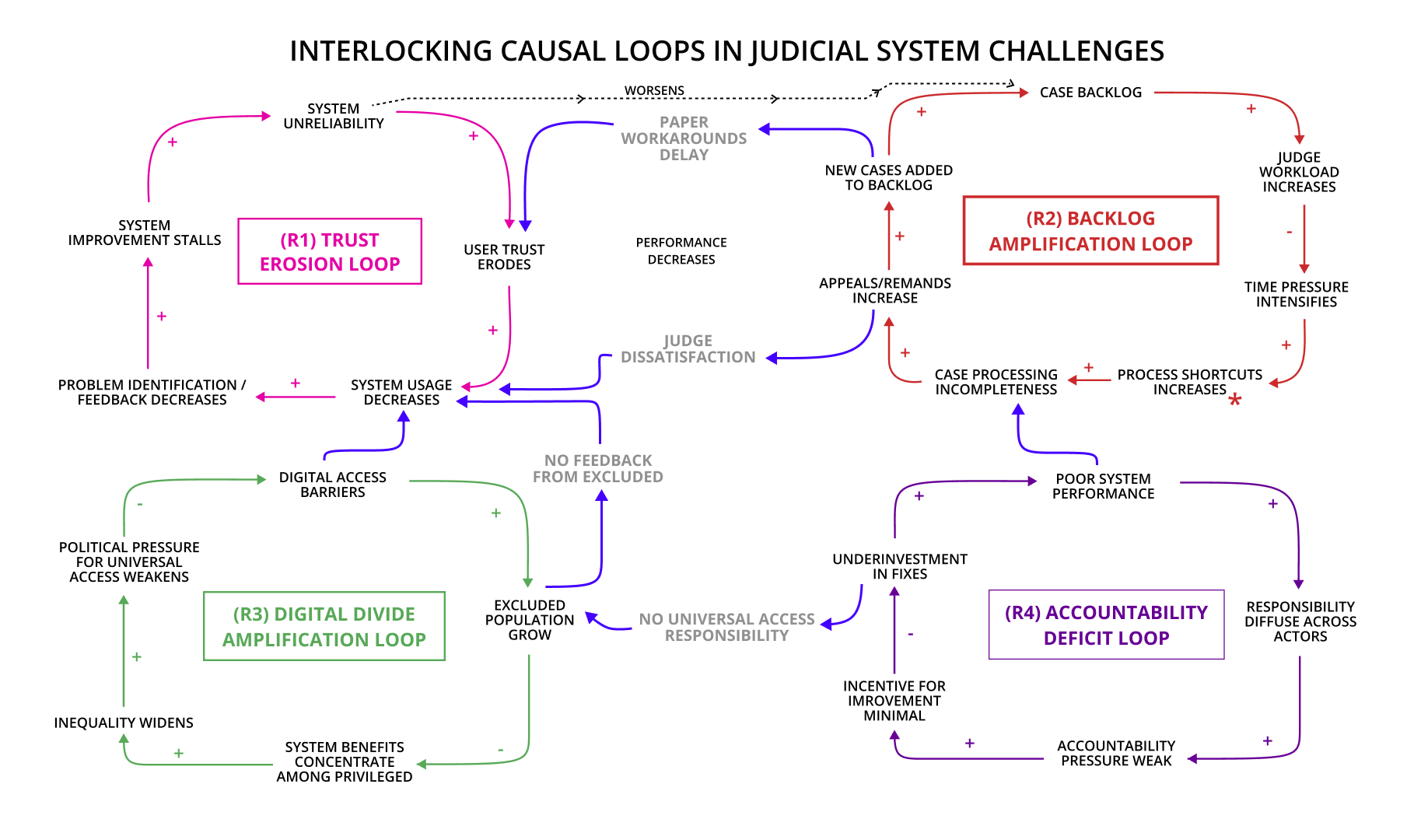
Four reinforcing loops, interlocked. The backlog loop (R2) is dominant: break it and the others loosen.
05
The Leverage Point
A judge who spends half the day on clerical coordination is not slow. The judge is doing two jobs, and only one of them requires a judge. If procedural time could fall to 10 or 15%, roughly a third of every judge's day returns to actual adjudication, without hiring anyone. Time pressure drops, hearings lengthen, judgment quality rises, remands fall, and the dominant loop starts running backwards.
That conditional is doing honest work: this is the hypothesis the diagnosis points to, not a measured result.
06
The Hypothesis: PAWS
The intervention paper proposes PAWS, a procedural automation system. Its design stance comes directly from the diagnosis: do not suppress the workarounds. Formalize them.
Every pillar of PAWS is a legitimized version of something practitioners already do. The misscan trick becomes a transparent validation flow with a real correction window. The phone-call search becomes search by name with automatic status updates. The paper shadow disappears only when digital becomes faster than paper, never by mandate. And AI drafts judgment structure and finds precedents, while the judge makes every decision. The clerk, never the judge.
| Pillar | Estimated time change |
|---|---|
| Automated filing and pre-validation | Filing: 2–3 hours → 15–20 minutes |
| Intelligent case files, one-click retrieval | Document retrieval: 10–15 minutes → 2–3 minutes |
| Automated hearing scheduling | Scheduling: 20–30 minutes → 2–3 minutes per hearing |
| Real-time hearing support, offline capable | No mid-hearing stalls; manual backup stays as safety net |
| AI-assisted judgment preparation | Research and drafting: 8–12 hours → 3–4 hours |
The proposal that matters most is not software. It is a rule change: measure judges jointly on disposal rate and remand rate, so speed and quality stop being opposed incentives. The current metric, disposal alone, is the mechanism that converts backlog into five-minute hearings. Change the payoff rule and the loop weakens even before any code ships.
07
What This Is and Isn't
The research is honest about its limits, and so is this page.
Desk research, not fieldwork.
We never sat in a courtroom. The workarounds come from published studies, not our own observation. Fieldwork would be the first step in taking this further: the analysis predicts what an observer should find, which makes it testable.
Estimates, not measurements.
The load-bearing numbers, 45 to 55% procedural time, 15 to 25% remand rates, are drawn from published research of varying rigor. The argument structure holds even if the exact figures shift, but they are inputs we inherited, not data we produced.
A hypothesis, not a solution.
PAWS has never been built or piloted. Its projections are theoretical. The paper says this plainly, and the proposal is framed for evaluation, with its assumptions and uncertainties listed, not for celebration.
A tension we chose to keep visible.
Our diagnosis condemns top-down, technology-first design. PAWS is itself a centrally designed system. The meta-design layer, where courts adapt procedures locally and co-evolve the system, is the attempted answer, but the tension is real and we would rather name it than hide it.
What the project changed for me: I stopped seeing interfaces as the unit of design. The eCourts portal is not badly designed because of its screens. It is badly designed because of its incentives, and no redesign of the screens touches those. The workarounds taught me that users are not the problem to be trained away. They are the system's most accurate documentation of what the design got wrong.
Skills and methods used
- Systems Thinking
- Institutional Analysis and Development (IAD)
- Resilience Engineering
- Causal Loop Modeling
- Socio-Technical Systems Analysis
- Swimlane Analysis
- Stakeholder Mapping
- Desk Research
- Research Synthesis
- Policy Analysis
- Intervention Design
- Service Design
- Academic Writing