Experience & Interaction · Concept
Netflix Flex
A speculative future where content stops being a fixed artefact. Format, length and depth mould themselves around the viewer.
Every show ships in one fixed shape. Your time does not come in fixed shapes.
A 2024 speculative concept where Netflix moulds format and runtime around the viewer. By 2026, the industry caught up.
01
Formats are fixed. Attention is not.
Every show ships in exactly one shape: a fixed number of episodes at a fixed length. Whether you have a free evening or a 20-minute lunch break, the content does not care.
The brief asked for a plausible future, not a fantasy. So the starting question was deliberately narrow: streaming already personalises what you watch. What happens when it starts personalising how you watch it? The recommendation engine was never the end state. It was the foundation for something bigger.
02
Mapping the future.
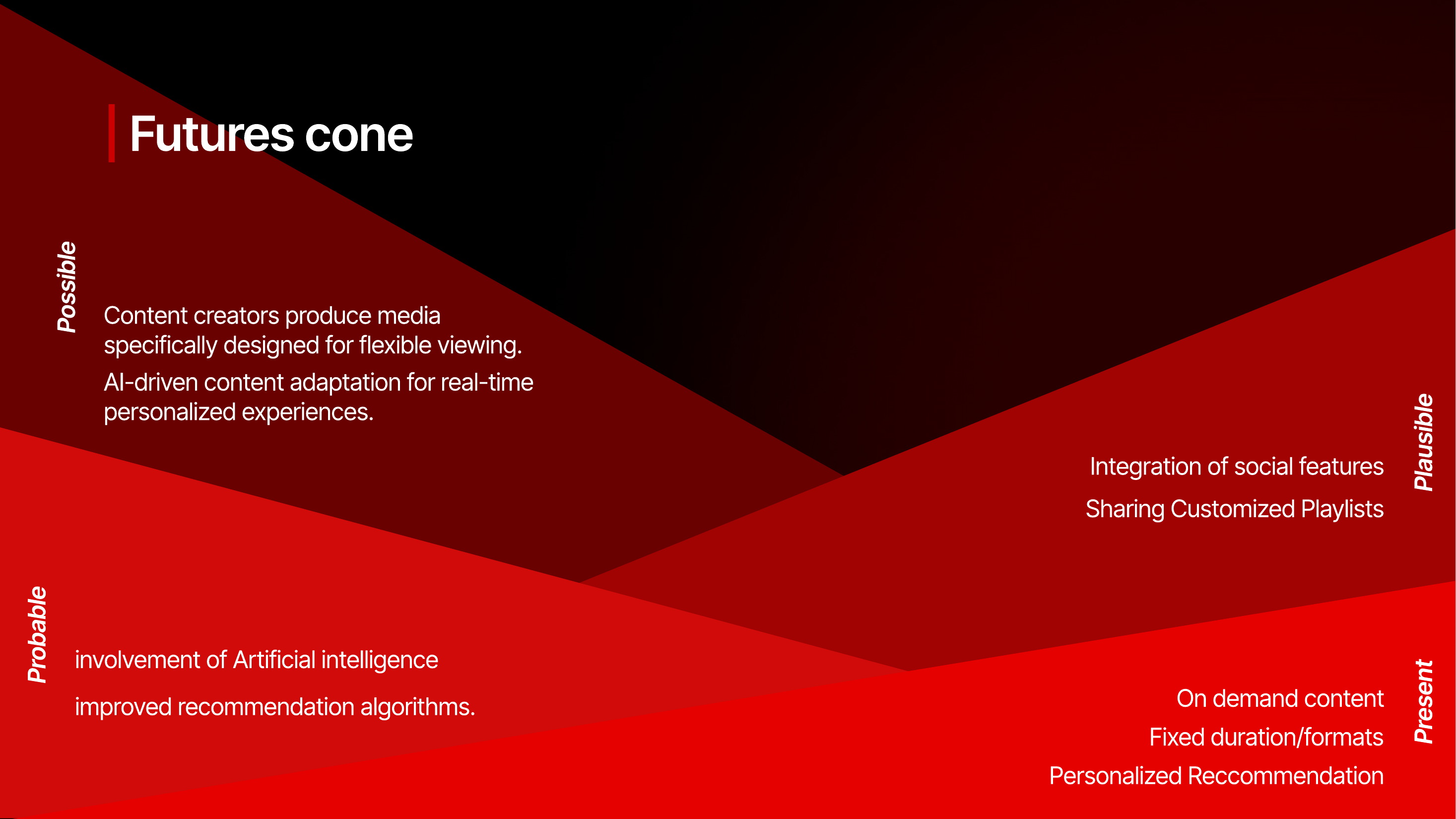
The futures cone kept the concept honest. Every feature had to trace back to a signal that already existed in 2024, one step at a time.
On-demand content, fixed durations and formats, personalised recommendation.
Deeper involvement of AI. Recommendation algorithms keep improving.
Social features and shared customised playlists. Viewing becomes configurable.
Creators produce media designed for flexible viewing. AI adapts content in real time for each viewer.
03
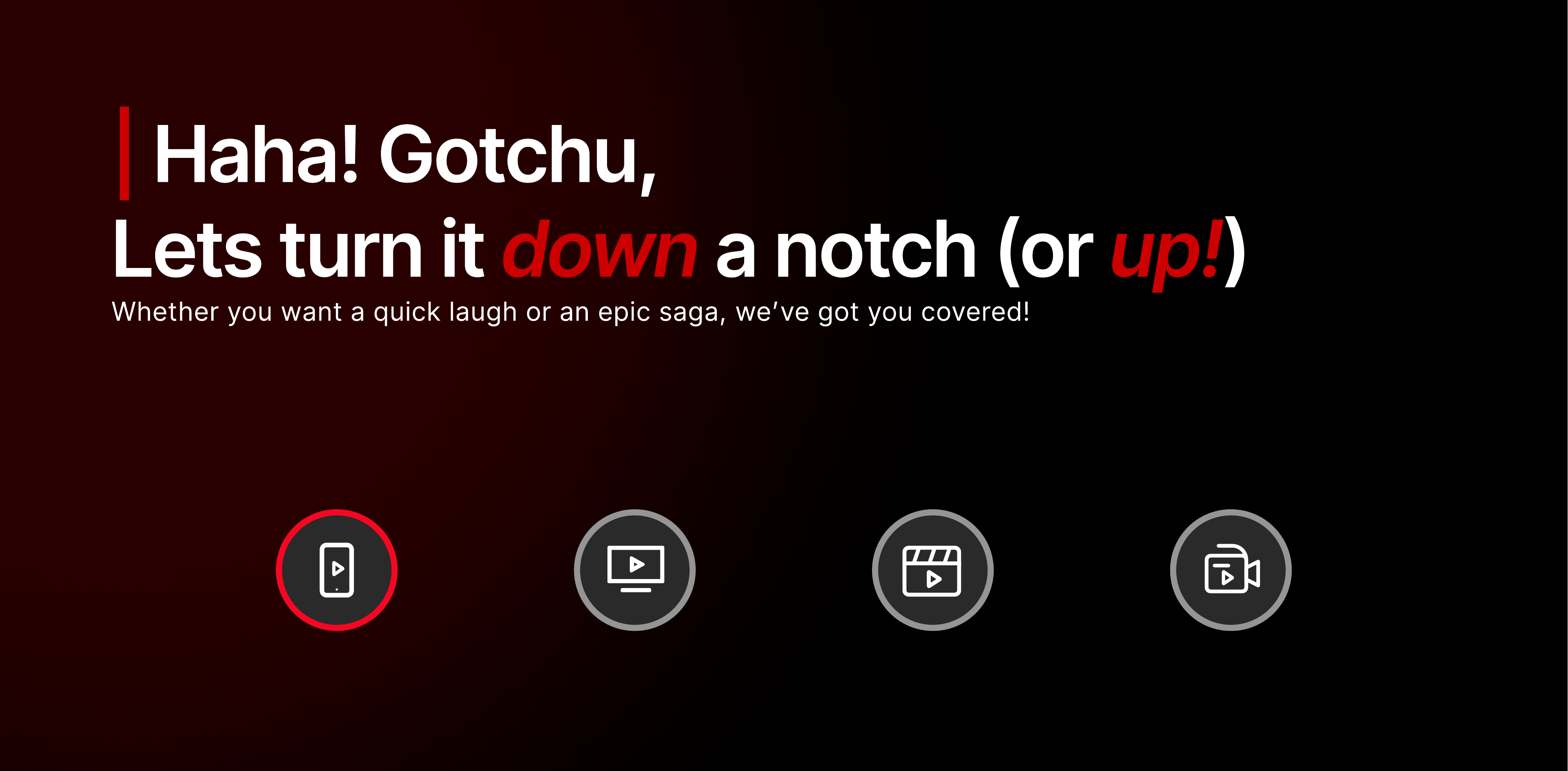
One story, four shapes.
Flex adds two controls to every title: a format selector and a duration slider. The format picks the shape. The slider picks the size, from a 10-minute cut to a 300-minute saga.
AI does the assembly, but the viewer holds the controls. Over time the system learns which mode fits which moment and starts suggesting the shape along with the show.
Episode Mode
The intentional binge. Episodic rhythm kept, cliffhangers intact. You decide how deep the night goes instead of being asked "are you still watching?"
Film Mode
A season stitched into one seamless film. No recaps, no credits, no week-long gap between cliffhangers.
Documentary Mode
The same story told through its making. Context, craft and behind-the-scenes woven into the narrative itself.
Snack Mode
Concentrated cuts for the time you actually have. Twenty minutes of story for a twenty-minute break.
04
The system behind the slider.
The interface was the easy part. The real design object was the production system: a story authored once that survives four shapes.
Flexible viewing breaks the current pipeline. Editing becomes modular, with scenes tagged and structured so each mode can assemble its own cut. Film Mode may need extra connective scenes shot up front. Snack Mode needs an editorial logic for what survives compression. The cost moves upstream: creators stop making one product and start making a system of products.
That trade-off is the heart of the concept. Higher production investment against a library where every title serves every time budget. It is not four versions of a show. It is one brilliant story that adapts to however you want to experience it.
05
Hindsight, 2026.
Designed as speculation in 2024. Two years on, it reads more like a roadmap.
Weeks after this project wrapped, Netflix launched Moments: save and share the exact scene you care about. The first crack in the fixed-format model.
Netflix rolled out Clips, a personalised vertical feed of short cuts from its own library, across major markets. Snack Mode in everything but name.
What the concept underestimated: reshaping a story is an authorship problem, not a compression problem. Narrative integrity is still the unsolved part, and the most interesting one.
06
What it taught.
Plausible futures are arguments, not predictions. The futures cone forced every feature to defend its link to a present-day signal.
Designing the screen was a fraction of the work. The decisions that mattered lived in the production system the screen implies.
Speculation has a shelf life, and that is its value. When reality catches up to a concept, you learn exactly which of your assumptions were structural and which were decoration.